
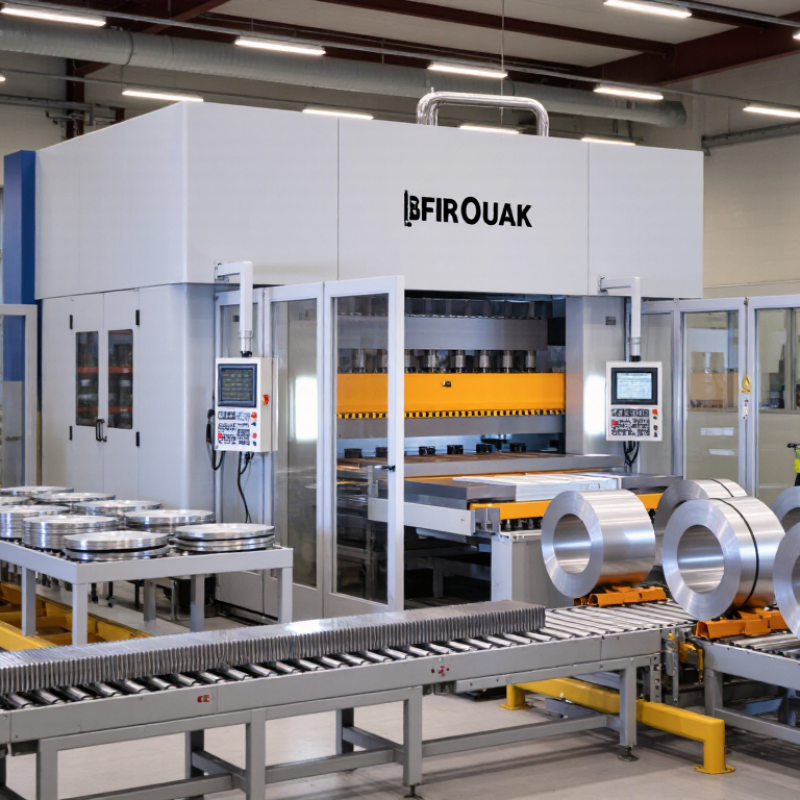
A fin press is a precision stamping machine for producing heat-exchanger fins. It feeds thin aluminum or copper strip through shaped dies. The dies create louvers, corrugations, collars, and controlled fin spacing. These parts later transfer heat inside air conditioners, chillers, refrigeration units, and vehicle cooling systems.
The equipment must hold tight tolerances across long production runs. Small pitch errors can restrict airflow or complicate tube assembly. Excessive burrs can damage operators, reduce contact quality, and increase scrap.
Practical sourcing checks should include feed accuracy, die-change time, press stability, lubrication control, and inspection records. Not glamorous, but important.
The International Energy Agency reports that buildings use about 30% of global final energy and create roughly 26% of energy-related emissions. The 2023 Global Status Report for Buildings and Construction places buildings and construction near 37% of global energy and process emissions. Efficient heat-transfer components therefore matter, although a fin press cannot guarantee system-level energy savings.
Design, assembly, airflow, and maintenance still decide performance. That limitation is easy to overlook.
A reliable supplier should provide sample parts, dimensional data, material traceability, and documented trial results before large-scale purchasing. (Sources: IEA, Energy Efficiency 2023; UNEP Global Status Report for Buildings and Construction 2023.)